
I could not run the annual Ionic Framework / Capacitor / Stencil Advent Calendar this year. I usually fill many slots myself and learn from others' posts—it was a highlight. Sorry about that this year. OSS alone had a heavy second half, so I focused on work outside writing.
Here I look back at what I did in 2025 and what happened in the Ionic / Capacitor community.
Ionic
Release cadence had slowed after the OutSystems acquisition and team reorg, but it is coming back bit by bit. As of now, Ionic v8.7.6 is latest.
A big change this year: new sales ended for pre-acquisition Commercial Products (Ionic Appflow, Identity Vault, etc.). Existing customer support continues on annual terms—it felt symbolic of the reorg.
https://ionic.io/blog/important-announcement-the-future-of-ionics-commercial-products
Ionic Theme
Ionic Framework currently supports iOS 18 and Material Design 2 designs. Apple and Google have moved on to iOS 26 and Material Design 3. I want to keep up before we look outdated.
The Ionic team is building Ionic Modular—a mechanism for users to supply themes. It is planned for v8, so for now iOS 26 and MD3 themes are community-driven. I worked with the Ionic team and shipped themes that work on current Ionic:
These let you apply iOS 26 and Material Design 3 to Ionic.
When Ionic Modular lands, applying themes gets easier—and CSS scaling and related work should simplify implementation too. I am really looking forward to it.
For reference, here is a post from Gonçalo M. on the Ionic team in Discord (#announcements on the Ionic server). It is translated below; skip Discord if you want the original only.
I hear excitement about implementing "Liquid Glass" themes and effects! It is a very cool design—I understand why people ask.
First and most important: Ionic Framework will absolutely not be deprecated!
We are focused on building Ionic's future—that is the real reason native Liquid Glass is on hold for now.We are monitoring Liquid Glass theme adoption in the design community. Given our current strategic focus, it is not on the immediate roadmap.
Why we are putting energy elsewhere:
Ionic Framework v9 Modular magic ✨
Our top priority is Ionic Framework v9. This release includes major architectural changes to make Ionic Modular.
Modular is the game changer! It is designed so the community can easily create and share custom themes—including ones that nail Liquid Glass—without waiting for us. We are building the foundation for exactly the design you want.While we work on core v9 architecture, we recognize immediate needs too. We are already collaborating closely with community members like @rdlabo so Ionic Modular work fully supports and enables the new Liquid Glass themes they are building.
Until v9 is ready, we will add features to make this effect easier with existing tools and CSS.Perfect implementation across all supported platforms without performance impact is a technical challenge, but prioritizing modular tooling first should deliver a better, more flexible product.
Thanks for the input—keep the ideas coming!
If Ionic is investing in Modular, my job is shipping high-precision OSS themes the day it releases. I am iterating steadily—stay tuned!
Ionic Documents
I strengthened Japanese translation for Ionic Framework docs. Ionic component docs are prose in Markdown for the first half; the second half (interfaces, properties, events, methods) is generated from @ionic/core.
Mid-year, an operations incident broke display of the Japanese first half. The second half showed Japanese on ionicframework.jp, but ionicframework.com/docs/ja stayed English for years (a script execution issue).
I opened a fix PR and it merged successfully!
https://github.com/ionic-team/ionic-docs/pull/4279
Docs are now almost fully available in Japanese. Note: https://ionicframework.com/docs/ja goes through approval, so for the latest use https://ionicframework.jp/docs.
Related Personal Libraries
@rdlabo/eslint-plugin-rules
My personal ESLint rule set. I added @rdlabo/rules/ionic-attr-type-check. Recent WebStorm shows type-check errors like this:
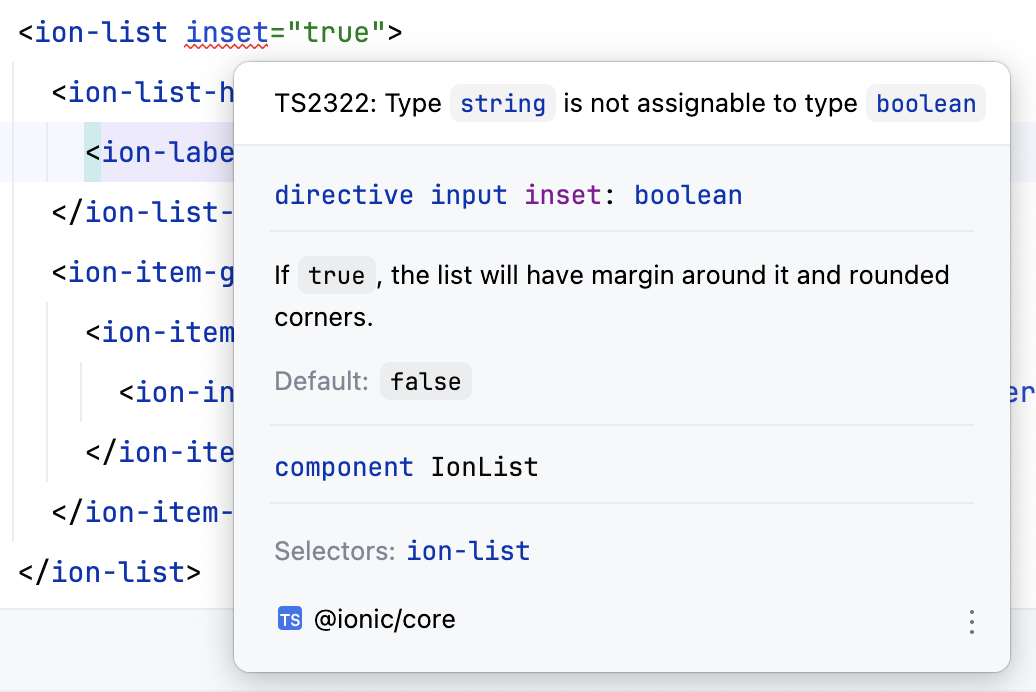
This TypeScript checking targets built Ionic components, so it does not block Angular builds.
Developers still benefit from seeing type errors to learn correct usage. I built an ESLint rule to catch this early with autofix.
@rdlabo/ionic-angular-collect-icons
Automates addIcons for Ionic Angular. It forked from @ionic/angular-standalone-codemods, but one package used pnpm and a structure I did not want.
I rebuilt the project layout, fixed non-parallel processing, and sped up runs. Available in v2.0.0.
Capacitor
Faster Capacitor Releases
Google Play announced a security policy: raise target API level every six months or you cannot ship updates.
https://support.google.com/googleplay/android-developer/answer/11926878?hl=ja
Capacitor now releases roughly every six months to keep up. This year alone brought Capacitor v7 and v8. Support for 16 KB page sizes was another major theme.
https://developer.android.com/guide/practices/page-sizes?hl=ja
The core is covered; plugins depend on their SDKs, but most actively maintained plugins should be done.
Capacitor iOS
Capacitor iOS moved from CocoaPods toward SPM. CocoaPods is scheduled for archival in December 2026, so the SPM migration deadline is approaching. Capacitor v8 defaults to SPM.
Capacitor Documents
Capacitor has Japanese documentation too. It was updated for the v8 release, including upgrade guides for the core and plugins—please use it.
Related Personal Libraries
Public Capacitor plugins I actively maintain:
- @capacitor-community/stripe
- @capacitor-community/stripe-identity
- @capacitor-community/stripe-terminal
- @capacitor-community/admob
- @capacitor-community/facebook-login
- @rdlabo/capacitor-brotherprint
- @rdlabo/capacitor-screenshot-event
- @rdlabo/capacitor-codescanner
- @rdlabo/capacitor-printer
v8 support for all of these will finish soon.
npm 2FA and Trusted Publish
This month npm made 2FA mandatory. Publishing a single package is fine—visit the URL shown during npm publish and complete 2FA. But with an npm workspace monorepo managing multiple packages, each package needs 2FA, which is impractical by hand.
I automated releases with trusted publish (provenance). Trusted publish lets CI environments like GitHub Actions publish to npm without 2FA. Latest npm enables provenance automatically from CI and proves package origin.
Details are in these articles. If you manage multiple packages in an npm workspace monorepo, consider adopting it.
https://zenn.dev/rdlabo/articles/0b5364331e0bf6
https://zenn.dev/rdlabo/articles/be8462ca01a6e1
Summary
2025 brought big changes to both Ionic Framework and Capacitor.
For Ionic, release cadence recovered somewhat after the OutSystems acquisition and reorg. Commercial Products stopped new sales—organizational change. Technically, Ionic Modular preparation progressed so the community can build themes; I shipped iOS 26 and Material Design 3 themes ahead of that so current Ionic can use latest designs. Japanese docs improved so more developers can learn Ionic.
Capacitor adopted a roughly six-month release cycle for Google Play API requirements. v7 and v8 shipped this year with 16 KB page size support and other platform shifts. On iOS, CocoaPods to SPM migration advanced; Capacitor v8 defaults to SPM. Many plugins finished v8 support and Japanese docs match v8.
For npm 2FA, I built trusted-publish automation so workspace monorepos publish without manual 2FA per package.
I wrote less but improved many libraries and docs through OSS. I hope it helped the Ionic and Capacitor community even a little. I want to keep contributing next year.
See you again.